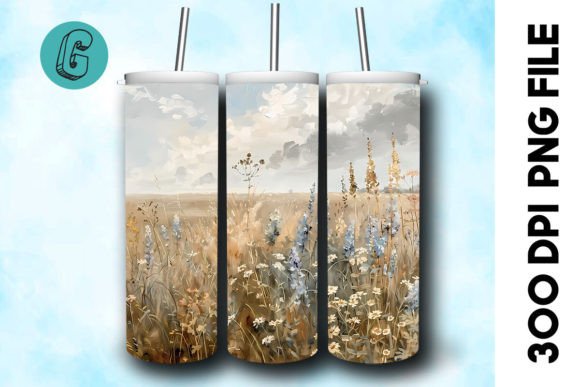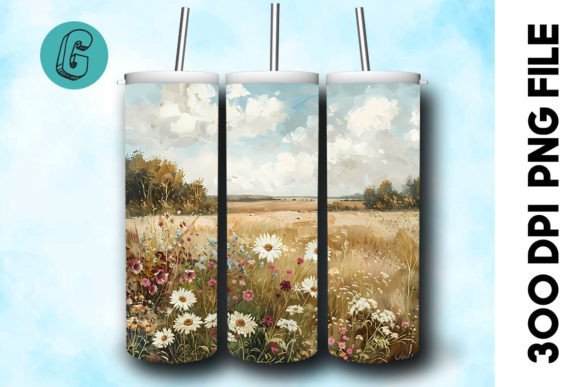
Oil Paint Wildflowers Tumbler Wrap 29
A Designer’s First Glance: Soft, Lush, and Purposefully Unfussy
Opening Oil Paint Wildflowers Tumbler Wrap 29, I felt immediate recognition—not of a trend, but of a mood. This isn’t a tight botanical illustration or a hyper-realistic floral. It’s loose, painterly, with implied brushstrokes and gentle layering—like wild poppies, lavender sprigs, and buttercups tossed onto canvas mid-stroke. The wrap format means it flows naturally around curved surfaces, which is exactly why I pulled it for a recent client request: custom embroidered linen tea towels for a local apothecary’s holiday gift set. As a designer who regularly translates digital graphics into stitched reality, I knew this background wouldn’t behave like a standard motif—it leans into softness, not sharpness.
Where It Shines (and Where It Asks for Thought)
Oil Paint Wildflowers Tumbler Wrap 29 works beautifully as a subtle yet expressive backdrop—not a focal point, but a quiet signature. On a lightweight cotton tote bag? Perfect. The design breathes across the fabric without overwhelming the hand-stitched handle accents or small monogram. On a relaxed-fit sweatshirt? Yes—but only if placed low on the back or along the sleeve cuff, where its organic flow complements movement rather than fighting it. For baby embroidery on a muslin swaddle or knit onesie, it adds warmth without visual clutter, especially when stitched in matte cotton thread over a pale oat or sage base.
It’s less ideal for high-contrast applications: think tiny caps, structured baseball hats, or densely textured terry cloth. Why? Because the design’s charm lives in its suggestion—not precision. Tiny satin-stitched petals or fine running-stitch stems would lose their character on a 3-inch hoop or under heavy stabilizer tension. Likewise, on dark fabric, some of the lighter washes and delicate highlights may vanish unless you adjust thread colors deliberately (e.g., cream instead of white, charcoal grey instead of black for shadowed stems).
Real Project Test: From Digital File to Handmade Product
Last week, I prepped Oil Paint Wildflowers Tumbler Wrap 29 for a batch of linen pillow covers destined for a boutique’s spring collection. My process was deliberate: first, I tested it on scrap linen with medium tear-away stabilizer—no floating, no puckering. Then I ran a black-and-white mockup to assess value contrast; the design held up well, with clear mid-tones guiding stitch placement. I chose three thread colors—dusty rose, sage green, and warm taupe—to echo the oil-paint palette without mimicking it literally. The result? A finished product that feels handmade, intentional, and quietly sophisticated—not “designed,” but *lived-in*.
That distinction matters. When customers see an embroidered item using Oil Paint Wildflowers Tumbler Wrap 29, they don’t read “digital download.” They read care, texture, and personality. That builds trust—especially for Etsy sellers and small shop owners whose brand hinges on authenticity, not perfection.
Practical Notes Every Embroidery Designer Should Check
- Test before committing: Run a full-size stitch-out on your target fabric—even if it’s just a corner scrap. Fabric texture changes everything.
- Stabilizer choice is non-negotiable: Lightweight woven fabrics need medium cut-away; knits require light tear-away + topping. Skip this, and the painterly looseness turns muddy.
- Thread color contrast > literal accuracy: Don’t chase the RGB version. Ask: Does this thread lift the design off the background? Does it read at arm’s length?
- Hoop size matters more than you think: This is a wrap-style graphic—so confirm your machine can handle the width comfortably. If your hoop maxes out at 4x4”, you’ll need to split or resize thoughtfully.
- Check licensing early: As a Graphics file in the Backgrounds category, Oil Paint Wildflowers Tumbler Wrap 29 is marketed for creative projects—but verify commercial use rights before listing finished embroidered goods or bundling it into your own digital product.
- Small details deserve scrutiny: Zoom in on petal edges and stem junctions. Are there areas where fill stitch density might cause stiffness? Could a running stitch replace a dense satin section for better drape?
Why It Fits So Well in Real Creative Businesses
This isn’t just another floral wrap. Oil Paint Wildflowers Tumbler Wrap 29 bridges digital ease and tactile intention. For craft business owners building cohesive collections—think matching tea towels, aprons, and baby blankets—it offers consistent visual language without repetition fatigue. For apparel decorators adding subtle branding to staff uniforms or boutique merch, it whispers rather than shouts. And for holiday embroidery or personalized gifts? Its warmth reads as thoughtful, not generic.
I’ve used it in printable mockups for client pitches—and every time, the response is the same: “It feels like *us*.” That’s the sign of strong design assets: they don’t dominate; they elevate. They don’t shout technique; they invite connection.
A Final Thought for Makers and Sellers
If you’re choosing Oil Paint Wildflowers Tumbler Wrap 29 for a machine embroidery design, remember: its strength is in suggestion, not specification. Let it guide your thread choices, your placement, your fabric pairings—not the other way around. Use it where softness serves your story: on a kitchen towel gifted to a new homeowner, on a patch sewn into a child’s backpack, on the back of a sweatshirt worn to a garden party. In those moments, it stops being a digital file and becomes part of something handmade, meaningful, and quietly memorable.